


A saas business broker service is a specialized intermediary that manages the full process of selling a subscription-based software company — from valuation and buyer outreach to negotiation, due diligence, and closing.
Here’s what a SaaS business broker service typically includes:
- Business valuation using SaaS-specific metrics like ARR, MRR, churn rate, LTV, and CAC
- Confidential Information Memorandum (CIM) preparation to present your business to buyers
- Targeted buyer outreach to strategic acquirers, private equity firms, and qualified operators
- NDA management and staged disclosure to protect sensitive data
- Negotiation support through Letters of Intent (LOIs) and competing offers
- Due diligence coordination covering financials, IP, tech stack, and legal documents
- Closing support including transition planning and post-sale handover
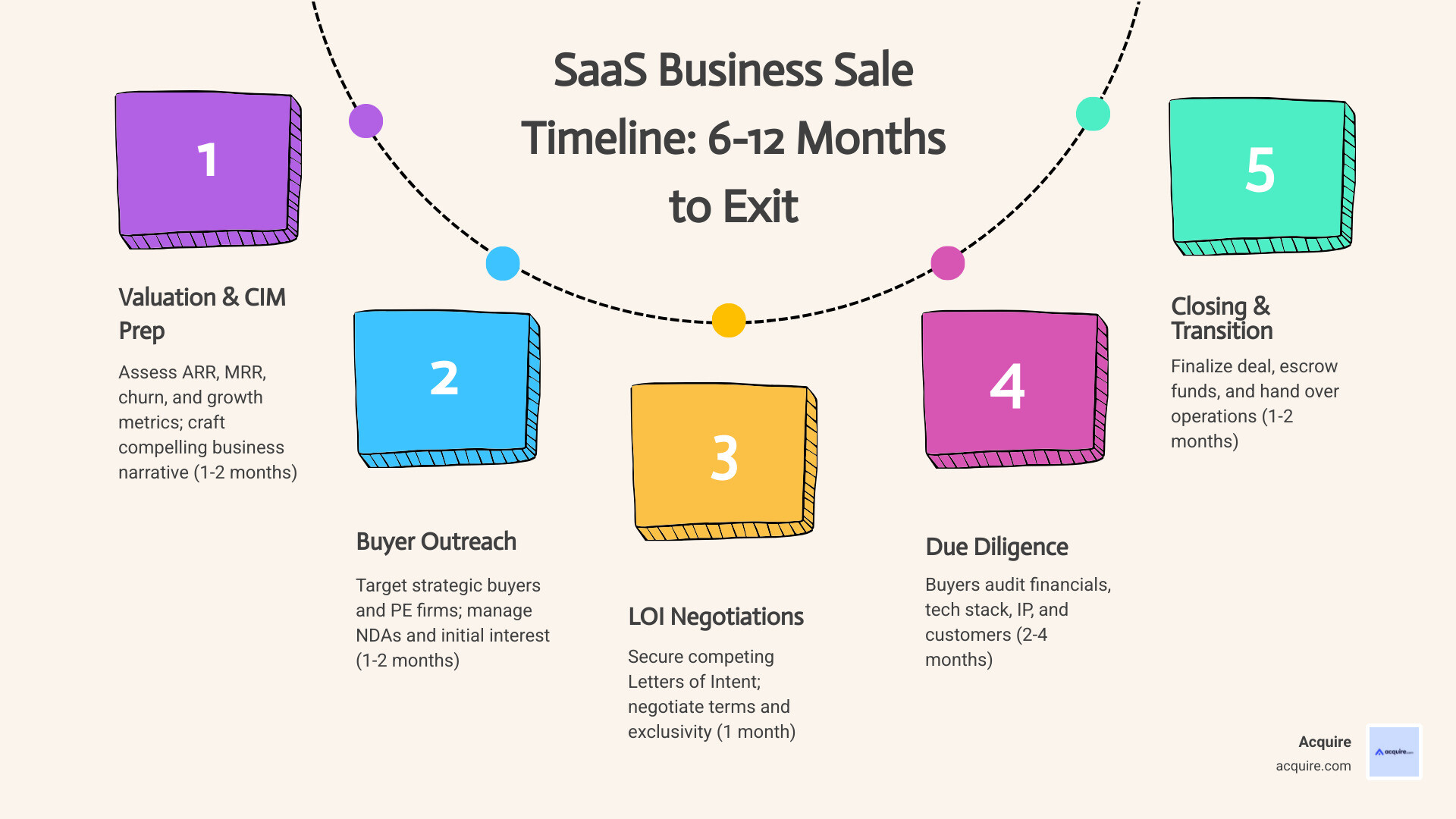
Most SaaS business sales take 6 to 12 months from first engagement to close. Larger or more complex deals can stretch longer.
Selling a SaaS company is not like selling a traditional business. Buyers are highly analytical. They dig deep into retention curves, revenue quality, customer concentration, and technical infrastructure. A mismatch between your deal size and a broker’s typical buyer pool can cost you months — and a significant chunk of your final multiple.
The SaaS sector generated over $261 billion in revenue in 2022 and continues to attract serious capital. That means more buyers, but also more competition for attention from the right ones.
The difference between a 3x and a 5x multiple often comes down to one thing: how well your sale process was run.
That’s exactly why choosing the right broker — or deciding whether you even need one — matters so much.
How a SaaS Business Broker Service Maximizes Your Exit Value
When you’re deep in the weeds of running a company, it’s hard to see the “forest for the trees” regarding your company’s market value. A professional saas business broker service acts as the essential bridge between your hard work and a life-changing wire transfer. They don’t just “list” your business; they curate a competitive environment where multiple buyers vie for the chance to acquire your recurring revenue.
The primary way a broker adds value is through deal flow and positioning. By knowing exactly which strategic buyers are currently “hungry” for specific tech stacks or customer niches, they can skip the cold-calling phase and go straight to decision-makers. This creates “valuation tension”—a fancy way of saying they make buyers sweat a little so they put their best offers forward.

What to Expect from a Professional SaaS Business Broker Service
A high-end broker doesn’t just look at your bank statements. They dive into the “SaaS alphabet soup” to build a narrative that justifies a premium multiple. You should expect them to masterfully present:
- ARR & MRR Quality: They distinguish between “sticky” subscription revenue and one-off professional services.
- Churn Rate Analysis: They don’t just give a number; they explain why customers leave and how you’ve stabilized retention.
- LTV & CAC: They prove that your unit economics are scalable, showing that for every dollar spent on marketing, you’re getting a massive return over the customer’s lifetime.
- Buyer Vetting: They act as a “bouncer,” ensuring only buyers with verified funds and a real track record get to see your sensitive data.
Specialized Brokers vs. General Digital Brokers
It’s tempting to go with a general business broker who sells everything from laundromats to e-commerce stores, but SaaS is a different beast. General digital brokers often focus on simple profit multiples (SDE), while a specialized saas business broker service understands that a fast-growing, pre-profit SaaS might actually be worth more than a profitable but stagnant one.
Specialized brokers understand cloud infrastructure costs, the “Rule of 40,” and how proprietary technology creates a competitive moat. They won’t get confused by your AWS bill or fail to explain the value of your API integrations to a non-technical buyer. In short, they speak the language of the cloud.
The 7-Step Roadmap to Selling Your Software Company
Selling a business is a marathon, not a sprint. While every deal is unique, most successful exits follow a structured path to ensure nothing falls through the cracks.
- Preparation & Valuation: This is where we look under the hood, clean up the books, and set a realistic price target.
- Marketing Material Creation: Building the “teaser” and the full Confidential Information Memorandum (CIM).
- Buyer Outreach: Quietly contacting the right people under strict NDAs.
- Initial Offers (IOIs): Reviewing non-binding expressions of interest to see who is serious.
- Management Presentations: You meet the buyers (virtually or in person) to “sell the dream.”
- The LOI Stage: Selecting the best offer and entering an exclusivity period.
- Due Diligence & Closing: The deep dive into your code, contracts, and finances, followed by the final Asset Purchase Agreement (APA).
| Sale Stage | Typical Duration | Key Focus |
|---|---|---|
| Preparation | 1-2 Months | Financial audits and SOP documentation |
| Marketing & Outreach | 1-3 Months | Generating buyer interest and NDAs |
| LOI Negotiation | 2-4 Weeks | Price, terms, and exclusivity |
| Due Diligence | 60-90 Days | Technical debt and legal verification |
| Closing & Handover | 2-4 Weeks | Asset transfer and training |
Preparing Your Confidential Information Memorandum (CIM)
Think of the CIM as the “biography” of your business. It’s a 30-to-50-page document that tells the story of how you started, why your customers love you, and—most importantly—how the next owner can make even more money.
A great CIM includes:
- The Business Narrative: Your “why” and your competitive advantages.
- Growth Levers: Explicitly stating where the “low-hanging fruit” is for a new owner.
- Tech Stack: A transparent look at your architecture and deployment pipelines.
- Operational SOPs: Proving that the business can run without you (this is huge for valuation).
Managing the Letter of Intent (LOI) and Due Diligence
The LOI is the “engagement ring” before the “marriage” (the closing). It sets the price and the timeline. However, it also usually includes an exclusivity clause, meaning you can’t talk to other buyers while the current one “checks your homework.
During due diligence, buyers will look for “deal-killers.” These are often technical debt (messy code that’s expensive to fix), customer concentration (one client making up 50% of revenue), or messy IP ownership (did that contractor in 2019 actually sign over the rights?). Professional M&A services help you identify these issues before you go to market so they don’t blow up your deal at the finish line.
Critical Metrics and Valuation Drivers in April 2026
As of April 2026, the market has become even more sophisticated. Buyers aren’t just looking at the “top line” anymore; they are obsessed with capital efficiency and the durability of your revenue.
- The Rule of 40: Your growth rate plus your profit margin should equal at least 40%. In 2026, this is the gold standard for healthy SaaS companies.
- Net Revenue Retention (NRR): This is the “holy grail.” If your NRR is over 100%, it means your existing customers are spending more with you every year, even without new sales.
- Gross Margins: For SaaS, these should ideally be 70-80%+. If they’re lower, you might be a “tech-enabled service” rather than a true software company.
Is a SaaS Business Broker Service Right for Your Deal Size?
Not every business needs a full-service broker. If you’re doing $50k in ARR, a broker’s minimum fees might eat up too much of your profit. However, once you cross the $1M ARR mark, the complexity of the deal usually justifies the commission.
- Micro-SaaS ($10k – $500k ARR): Often best suited for marketplaces where you can manage the sale yourself with some expert guidance.
- Mid-Market ($1M – $10M ARR): This is the “sweet spot” for a saas business broker service. You need a narrative to attract private equity and strategic buyers.
- Enterprise ($10M+ ARR): These deals often move into the realm of full-scale investment banking.
To see where you stand, it’s always smart to get a free SaaS valuation to understand your market position.
Addressing Customer Concentration and Founder Dependence
Two of the biggest “multiple-crushers” are customer concentration and founder dependence. If you are the only one who can close sales or fix the server, your business isn’t an asset—it’s a job.
To maximize value, you must:
- Diversify Revenue: Ensure no single customer accounts for more than 10-15% of your revenue.
- Build a Management Layer: Hire or promote people to handle daily operations so the business survives your exit.
- Document Everything: Turn your “brain power” into Standard Operating Procedures (SOPs).
Broker Fees, Commissions, and Confidentiality Protocols
Let’s talk about the elephant in the room: cost. Most SaaS brokers work on a success fee model, typically charging 10-15% of the final sale price. For very large deals (over $20M), this percentage often scales down. Some boutique firms may also charge an upfront retainer to cover the costs of valuation and marketing materials.
Confidentiality is the other major pillar. You don’t want your employees or competitors knowing you’re for sale until the ink is dry. Brokers manage this through:
- Blind Teasers: Marketing the business without naming it (e.g., “B2B HR Tech SaaS with $2M ARR”).
- Ironclad NDAs: Ensuring no one gets “under the hood” without legal protection.
- Staged Disclosure: You don’t show the source code on day one. You reveal more as the buyer proves their seriousness.
If you’re curious about what’s currently moving in the market or considering buying a SaaS business, you can browse SaaS companies for sale to see how others are positioning their exits.
Frequently Asked Questions about SaaS Sales
How long does it usually take to sell a SaaS company?
The typical timeline is 6 to 12 months. The first 2 months are usually spent on preparation and valuation, followed by 2-4 months of marketing and outreach. Once an LOI is signed, due diligence usually takes 60 to 90 days. If your financials are messy or your tech stack is complex, expect it to take longer.
Can I sell my SaaS business without a broker?
Absolutely. Many founders choose the “DIY” route using marketplaces to save on commission. This works best for smaller deals or if you already have a background in M&A. The trade-off is your time. You will have to vet every buyer, answer every “tire-kicker” email, and manage the legal back-and-forth yourself. For many, the 10% commission is a small price to pay for the hundreds of hours saved.
What is the difference between an app broker and a SaaS broker?
It comes down to the revenue model. App brokers often deal with mobile or web apps that monetize through one-time purchases or ads. SaaS brokers specialize in the subscription economy. They understand recurring billing, “sticky” customer lifecycles, and the specific accounting rules (like ASC 606) that govern how software revenue is recognized.
Conclusion
Exiting your company is likely the most significant financial event of your life. Whether you choose to use a full-service saas business broker service or leverage a high-tech marketplace, the goal remains the same: a clean, stress-free exit that rewards you for your years of innovation.
At Acquire.com, we’ve simplified this journey. We provide a marketplace that connects you with over 500k+ vetted entrepreneurs, integrated with Escrow.com for total security. Whether you need expert M&A support to handle the “heavy lifting” or just a platform to find the perfect buyer, we’re here to ensure your exit is nothing short of life-changing.
Ready to see what your hard work is worth? Start your SaaS exit journey with us today.