


Understanding What Makes Ecommerce Valuation Unique
Valuing an ecommerce business isn’t the same as assessing a traditional brick-and-mortar store. The digital landscape introduces unique factors that significantly influence an online business’s worth. Traditional valuation methods often fall short, requiring adjustments to accurately capture the potential of an ecommerce venture. For anyone exploring how to value an ecommerce company, understanding these nuances is crucial for both buyers and sellers.
Key Differences in Ecommerce Valuation
One key distinction is scalability. Unlike physical stores constrained by location and inventory, online platforms can potentially reach a global audience with less overhead. This potential for rapid growth is a major value driver, particularly for businesses with proven systems and a strong online presence. A successful online retailer, for example, can expand into new markets by leveraging existing infrastructure. A traditional retailer, in contrast, requires significant capital investment for similar expansion.
The digital footprint itself also holds substantial value. This includes website traffic, search engine rankings, social media presence, and email lists. These assets represent a direct line to customers, often difficult and costly to replicate. Ecommerce businesses with established digital footprints have a built-in advantage. They attract higher valuations because of their existing audience and market reach.
The Impact of Market Dynamics and Growth
Another difference lies in the focus on customer acquisition metrics. In ecommerce, the cost of acquiring a new customer and their lifetime value are crucial indicators of profitability and long-term sustainability. These metrics provide insights into marketing campaign effectiveness and potential for revenue generation.
The ecommerce market is dynamic and rapidly expanding. Global retail ecommerce sales reached approximately $6 trillion and are expected to increase by 31% in the near future. Projections for 2025 specifically forecast sales to reach $7.4 trillion, a significant 74% jump from the $4.2 trillion recorded in 2020. This booming market presents both opportunities and challenges, influencing what buyers are willing to pay and how sellers position their businesses.
Ecommerce-Specific Value Drivers
Finally, certain characteristics are particularly valuable in ecommerce, leading to higher valuations. These include:
- Recurring Revenue Streams: Subscription models and loyalty programs create predictable income, making them attractive to investors.
- Proprietary Technology: Unique software or platforms provide a competitive edge and differentiate a business.
- Strong Brand Equity: A recognizable brand and loyal customer base command premium valuations.
Understanding how these elements contribute to an ecommerce company’s overall value is crucial for anyone involved in buying or selling online businesses.
The Valuation Multiples That Actually Matter
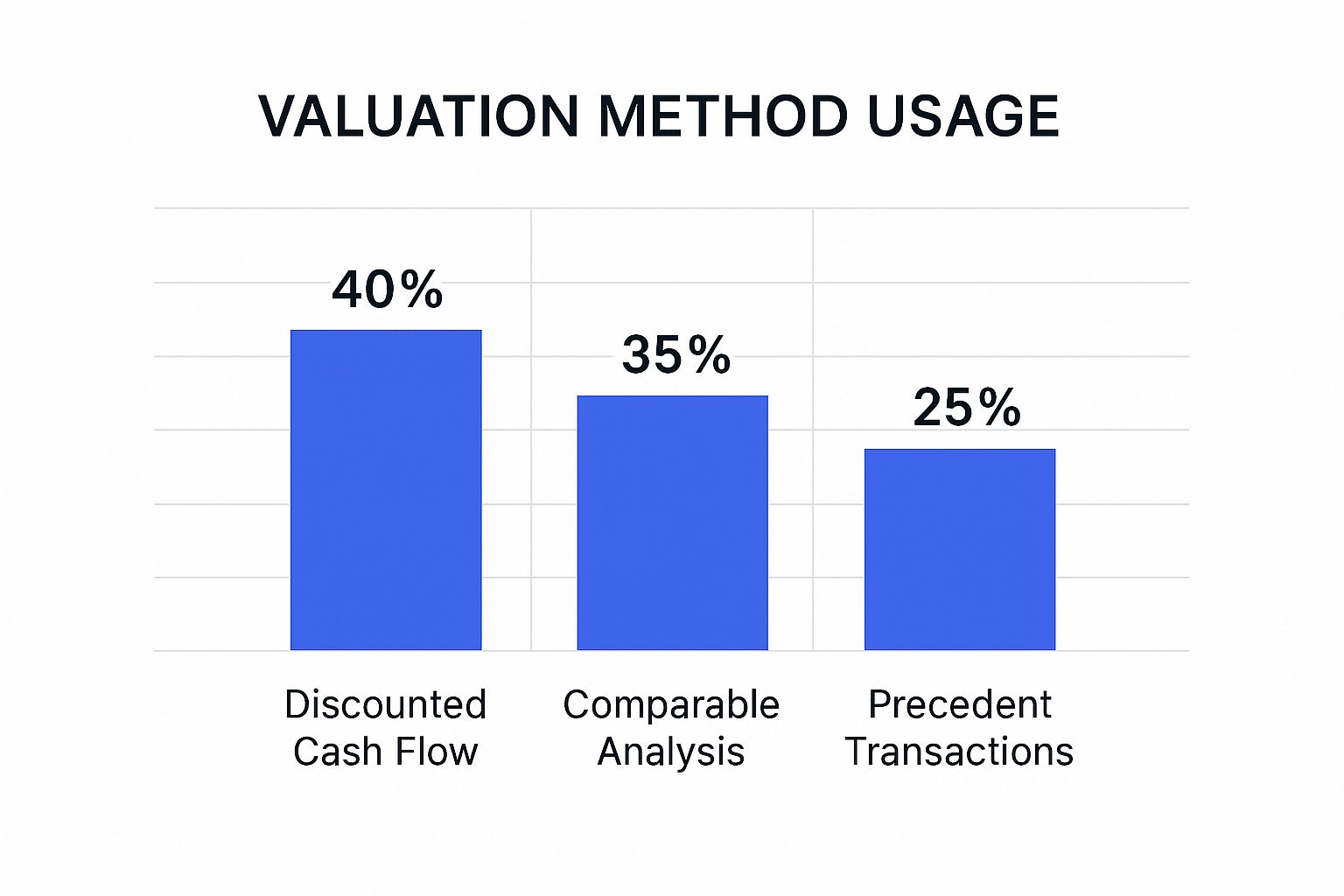
The infographic above illustrates how frequently different valuation methods are used. Discounted Cash Flow (DCF) accounts for 40%, Comparable Analysis represents 35%, and Precedent Transactions make up 25%. This data clearly shows that while several valuation approaches exist, DCF analysis remains a primary method for ecommerce businesses.
While it’s important to understand the specific nuances of ecommerce valuation, the fundamental principles of business valuation still hold true. This means understanding the valuation multiples that buyers use.
These multiples offer a quick way to assess the relative value of a business based on its financial performance. A higher multiple generally indicates a greater perceived value and stronger future growth potential.
Common Ecommerce Valuation Multiples
Several key multiples are frequently used in the ecommerce world:
- Revenue Multiple: This multiple expresses a business’s value relative to its annual revenue. It’s often used for early-stage companies where profitability hasn’t yet been established. However, revenue alone doesn’t provide a complete picture. Factors such as revenue quality and growth trajectory significantly influence the applicable multiple.
- EBITDA Multiple: Earnings Before Interest, Taxes, Depreciation, and Amortization (EBITDA) represents a company’s earnings before considering non-operating expenses. This multiple is often used for established, profitable businesses, giving a clearer view of operational performance.
- SDE Multiple: The Seller Discretionary Earnings (SDE) multiple is commonly used for smaller ecommerce businesses. It adjusts earnings by adding back owner compensation and other discretionary expenses, providing a standardized view of profitability. Valuation multiples are a fundamental method for valuing an ecommerce company. In 2025, typical revenue multiples can vary significantly depending on factors like growth potential, customer retention, and revenue diversification.
To help illustrate the differences between these multiples, let’s look at the following table:
Ecommerce Valuation Multiples Comparison
| Valuation Multiple | Typical Range | Best For | Key Considerations |
|---|---|---|---|
| Revenue Multiple | 1x – 5x | Early-stage, high-growth companies | Revenue quality, growth trajectory |
| EBITDA Multiple | 5x – 15x | Established, profitable businesses | Operational performance, scalability |
| SDE Multiple | 2x – 6x | Small businesses with owner-operators | Normalized profitability, add-backs |
As shown in the table, the appropriate multiple depends on the stage and characteristics of the business. Early-stage companies often focus on revenue multiples, while mature businesses might use EBITDA.
Factors Influencing Multiples
Several factors can influence which multiple is most appropriate and its specific value:
- Growth Rate: Faster-growing businesses typically command higher multiples, reflecting their potential for future returns.
- Profitability Margins: Strong profit margins show efficiency and the ability to generate cash flow, increasing attractiveness to buyers.
- Customer Retention: High customer retention suggests a loyal customer base and lower customer acquisition costs, positively impacting valuations.
- Competitive Landscape: A business in a less competitive market may have a higher multiple due to its stronger market position.
- Market Conditions: Broad economic conditions and industry trends can also influence valuations and buyer interest.
Choosing the Right Multiple
Choosing the right multiple requires careful consideration of the specific characteristics of the ecommerce business. A revenue multiple might be suitable for early-stage, high-growth companies. Established, profitable businesses often use EBITDA, while SDE is common for smaller businesses with owner-operators. When exploring how to value an ecommerce company, analyzing these factors and researching comparable transactions can help determine a realistic and justified valuation.
Beyond Revenue: Analyzing Quality and Growth Trajectory

When valuing an e-commerce company, revenue is just the beginning. Savvy buyers know that revenue streams vary in their stability and potential. They distinguish between reliable, long-term income and more precarious sources. This section explores how acquisition professionals assess revenue quality.
Recurring Revenue vs. One-Time Transactions
A key aspect of revenue quality is the percentage of recurring revenue. Subscription services, loyalty programs, and repeat purchases create predictable income, making a business more appealing to potential buyers. This stability reduces risk and provides a solid base for future expansion.
Businesses relying on one-time transactions face more uncertainty and may be seen as less valuable. Compare a subscription service with consistent monthly income to a retail store dependent on seasonal sales fluctuations. The former offers more predictability and, therefore, less risk. Understanding these differences is essential when learning how to value an ecommerce company, since recurring revenue streams often command higher valuations than one-time sales models.
Customer Acquisition Cost and Lifetime Value
The relationship between customer acquisition cost (CAC) and customer lifetime value (CLTV) is another critical metric. A lower CAC compared to CLTV indicates efficient customer acquisition and long-term profitability.
This healthy ratio suggests a sustainable business model and positive growth potential. For instance, a $10 CAC for a customer with a $100 CLTV demonstrates a strong return on marketing investment. This positive dynamic significantly influences how buyers value an e-commerce company.
Channel Diversification
Channel diversification is vital in revenue quality assessment. Businesses overly reliant on a single sales channel, such as exclusively selling through Amazon, are vulnerable to policy changes or market shifts.
Diversifying across multiple channels – a dedicated website, social media platforms, and various online marketplaces – reduces this risk and enhances resilience. A wider reach creates a more robust business, less susceptible to disruptions in any single channel.
Normalized Historical Performance
Valuing an e-commerce company accurately involves normalizing historical performance. This means adjusting past revenue figures to account for one-time events, seasonality, and other unusual occurrences.
This process provides a clearer view of the business’s core performance and enables more accurate projections. For example, adjusting for a temporary sales spike from a viral marketing campaign reveals a more realistic baseline.
Credible Revenue Projections
Finally, strong valuations require credible revenue projections. These projections should be based on historical data, market trends, and identifiable growth drivers.
Buyers carefully examine projections, looking for realistic assumptions and supporting evidence. Clearly outlining these factors builds confidence in the business’s future potential and supports a higher valuation. Highlighting sustainable growth drivers further strengthens these projections. By showcasing market understanding and achievable growth strategies, business owners not only inspire buyer confidence but also provide clarity on how to value an ecommerce company in a way that reflects long-term potential.
Profit Metrics That Drive Premium Valuations

While revenue growth is important, profitability is key for an ecommerce company’s value. Buyers look for healthy profit margins and efficient operations. Having a subscription model can significantly impact future growth. This section explores the profit metrics that are most important when valuing an ecommerce business.
Key Profitability Metrics
Smart buyers look beyond top-line revenue and analyze specific profitability metrics:
- Gross Margin: This shows the difference between revenue and the cost of goods sold (COGS). A higher gross margin usually means efficient production and good pricing strategies. It demonstrates the company’s ability to manage direct costs.
- Contribution Margin: This metric subtracts variable costs, like manufacturing and shipping, from revenue. It highlights how much each sale contributes to fixed costs and profit. A strong contribution margin shows good pricing and operational efficiency.
- Fulfillment Costs: These include warehousing, shipping, and handling. Optimizing fulfillment is crucial for profitability. Buyers want to see how fulfillment costs scale with revenue growth. They look for efficient and sustainable practices.
Industry Benchmarks and Operational Efficiency
Industry benchmarks play a vital role in understanding how to value an ecommerce company. Buyers often compare profit metrics against competitors to identify strengths and weaknesses. For example, if a business shows a lower gross margin than the industry average, it could signal pricing challenges or operational inefficiencies that impact overall valuation.
Operational efficiency is a major driver of profitability. Buyers want to see streamlined processes, good inventory management, and efficient customer service. These efficiencies directly affect profit margins and the overall valuation.
To understand how your business stacks up against the competition, take a look at the table below. It outlines industry-standard profit margins and key operational metrics across different business sizes.
Ecommerce Profitability Benchmarks by Business Size
| Metric | Small Business (<$1M) | Mid-Size ($1M-$10M) | Enterprise (>$10M) |
|---|---|---|---|
| Gross Margin | 40-50% | 50-60% | 60-70% |
| Net Profit Margin | 5-10% | 10-15% | 15-20% |
| Average Order Value (AOV) | $50-$100 | $100-$200 | $200+ |
| Customer Acquisition Cost (CAC) | $20-$50 | $50-$100 | $100+ |
| Conversion Rate | 1-2% | 2-3% | 3-4% |
As you can see, larger businesses generally benefit from economies of scale, leading to higher margins and greater efficiency. However, opportunities for improvement exist across all sizes.
Operational Improvements That Boost Valuation
Several operational changes can greatly improve an ecommerce company’s value:
- Inventory Management Optimization: Reducing excess inventory and improving forecasting minimizes storage costs and frees up capital. This leads to higher profit margins.
- Customer Service Efficiencies: Streamlining customer service with tools like Zendesk or Intercom can reduce costs and improve customer satisfaction, affecting both profitability and customer lifetime value.
- Marketing Spend Realignment: Optimizing marketing campaigns to improve return on investment (ROI) lowers customer acquisition cost (CAC) and drives more profitable growth.
Identifying Quick-Win Profit Enhancements
Even small profitability improvements can make a big difference in valuation. Finding quick wins, like better supplier rates or optimized shipping costs, shows a commitment to efficiency and makes a company more appealing to buyers. These actions demonstrate a proactive approach to maximizing value.
Quantifying Your Digital Assets and Competitive Moats
Your ecommerce company’s value goes beyond the balance sheet. Savvy buyers look for the digital assets and competitive advantages that drive long-term growth. This is where you can truly stand out and justify a higher valuation. 
Valuing Your Digital Assets
Identifying and quantifying these assets is key when determining how to value an ecommerce company. A robust email list, for instance, isn’t just a collection of contacts; it’s a direct line to potential customers. It represents a pre-built audience eager to learn about new products and promotions, leading to lower customer acquisition costs and higher potential revenue.
Here’s how to approach valuing key digital assets:
- Customer Data: Analyze your customer data for valuable insights into purchasing behavior, demographics, and preferences. This data allows for personalized marketing and improved customer lifetime value. The more detailed and segmented your data, the more valuable it becomes.
- Email Lists: A large, engaged email list provides a direct marketing channel. Segmenting your list based on engagement and demographics further increases its value. Use metrics like open rates, click-through rates, and conversion rates to demonstrate its effectiveness.
- Content Library: High-quality content, such as blog posts, articles, videos, and guides, attracts organic traffic and establishes your brand as a leader in your niche. A strong content library boosts SEO, drives traffic, and cultivates brand loyalty, making it attractive to potential buyers.
- Proprietary Systems: Custom-built software or tools that improve operations, enhance the customer experience, or offer a competitive edge are highly valuable. These systems often provide unique functionalities not found in standard solutions, making them significant differentiators.
Identifying and Articulating Competitive Advantages
Besides tangible digital assets, competitive moats or sustainable competitive advantages are equally crucial. These advantages protect your market share and make it harder for competitors to copy your success.
Consider these key competitive moats:
- Brand Equity: A strong brand reputation and a loyal customer base often command premium valuations. This translates into higher customer lifetime value and reduced acquisition costs.
- Exclusive Relationships: Exclusive agreements with suppliers or distributors offer access to unique products or better pricing, creating a significant barrier to entry for competitors.
- Technological Innovations: Proprietary technology, innovative processes, or unique fulfillment strategies can give your business a distinct advantage in the market.
Strengthening Your Position Before Valuation
Before undergoing a valuation, take steps to enhance your digital assets and competitive advantages. This proactive approach can greatly influence the valuation of your ecommerce business and increase its overall worth.
Here are some practical steps:
- Document Everything: Create thorough documentation of your digital assets and competitive moats. This should clearly explain the value of each asset and its contribution to the business’s success, helping potential buyers understand their true worth.
- Improve Data Hygiene: Ensure your customer data is clean, accurate, and well-organized. This enhances the value of your data for personalized marketing and targeted campaigns.
- Enhance Website Performance: Optimize your website for speed, mobile responsiveness, and user experience. This not only improves SEO and conversion rates but also strengthens your online presence.
- Formalize Relationships: Document and formalize all exclusive relationships with suppliers or distributors. This clarifies agreement terms and simplifies the transfer of these relationships to a new owner.
By proactively addressing these areas, you’ll present a more compelling case for a higher valuation and set up your ecommerce business for a successful acquisition. A strong valuation relies on the combination of solid financials and valuable intangible assets that drive future growth and profitability.
Building a Bulletproof DCF Model for Your Ecommerce Business
A Discounted Cash Flow (DCF) analysis offers one of the most detailed approaches for understanding how to value an ecommerce company. Unlike relying solely on valuation multiples, this method digs into projected future cash flows to provide a clearer picture of true business worth. This guide will walk you through building a robust DCF model tailored for ecommerce, from projecting cash flows to presenting your analysis to potential buyers.
Projecting Realistic Future Cash Flows
The core of a DCF model is its future cash flow projections. For ecommerce businesses, this means analyzing past performance, factoring in growth plans, and considering market trends. Start by normalizing historical revenue, adjusting for unusual events or seasonality. This creates a clearer understanding of the underlying business performance and sets the stage for future projections.
Next, pinpoint your key growth drivers. Are you entering new markets? Launching new product lines? Improving conversion rates? Clearly documenting these initiatives makes your projections stronger and more believable to potential buyers.
Determining the Appropriate Discount Rate
The discount rate represents the risk associated with your ecommerce business. A higher discount rate signifies higher risk and reduces the present value of future cash flows. Factors impacting the discount rate include industry risk, company-specific risk, and the broader economic environment. Accurately evaluating your risk profile is critical for a realistic valuation.
Incorporating Different Scenarios
Creating a reliable DCF model means considering a range of scenarios. Start with a base case scenario based on your most likely projections. Then, develop both optimistic and pessimistic scenarios to show the business’s ability to withstand different market conditions.
This range of scenarios offers a complete picture of possible outcomes, strengthening your valuation argument. Consider the potential impact of factors such as a sudden economic downturn or a successful viral marketing campaign.
Interpreting the Valuation Range and Presenting Your Analysis
Your DCF model will produce a range of potential valuations depending on the various scenarios. Understanding this range and its underlying factors is crucial for effective negotiation. When presenting your DCF analysis to potential buyers, highlight the key assumptions and growth drivers behind your valuation.
Clearly explain how your projections are rooted in historical performance and reasonable market expectations. A well-organized and financially sound presentation builds buyer confidence and justifies your asking price.
Ready to explore selling your ecommerce business? Visit Acquire.com to connect with potential buyers.