


Navigating Your Business Acquisition Funding Landscape
Knowing how to finance a business purchase is a major step, and understanding the available funding options is essential for a successful outcome. This process often involves mergers and acquisitions (M&A) activity, a market significantly affected by the overall economic climate.
For instance, experts predict a rise in M&A volume in 2025, despite geopolitical uncertainties, thanks to anticipated lower inflation and improved economic stability. This projected resurgence should create more opportunities for financing business purchases through various financial instruments. While 2024 saw a less dramatic increase in M&A financing due to higher interest rates, the outlook for 2025 remains positive, with a projected rebound in strategic investments.
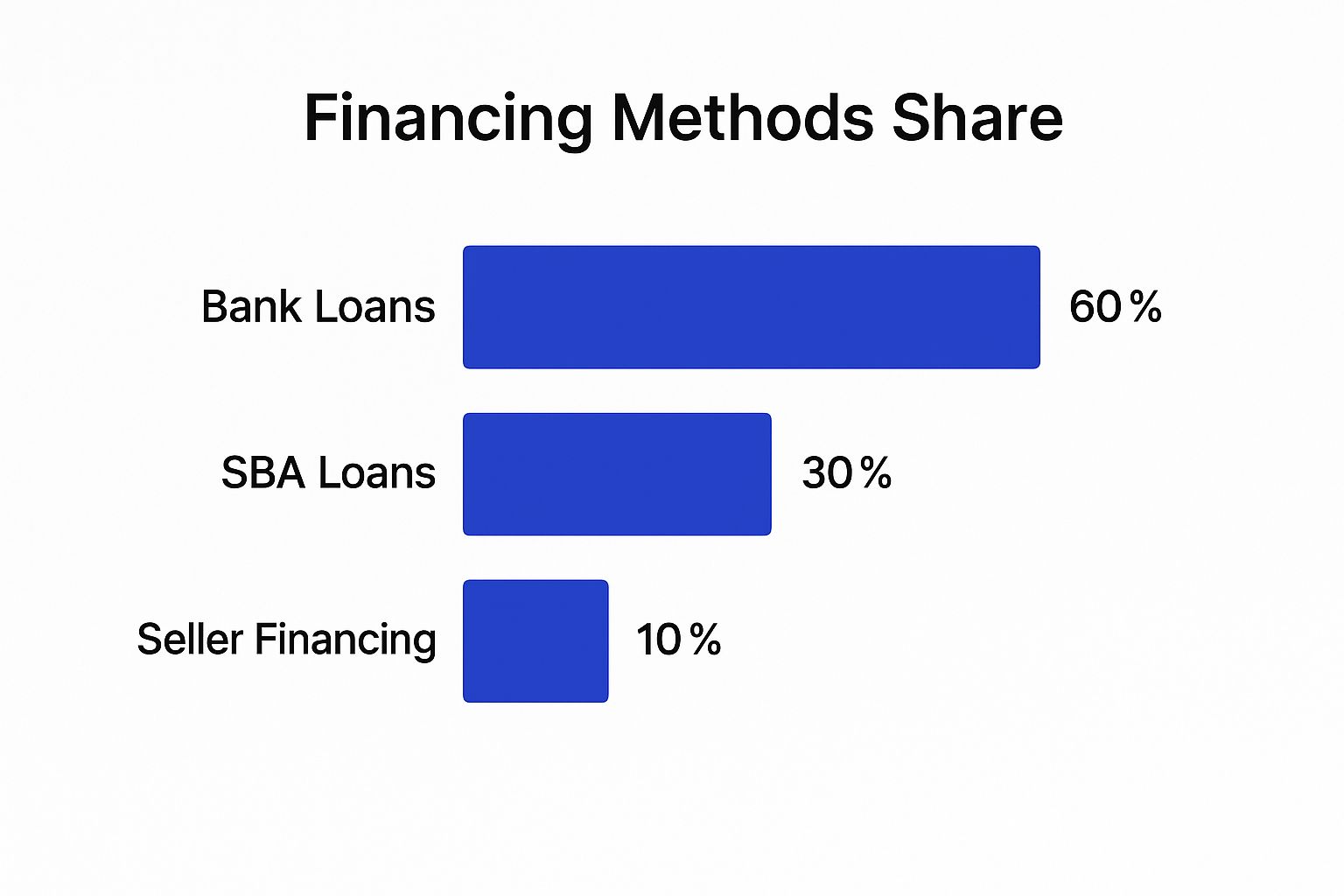
The data chart above visualizes the distribution of financing sources used in business acquisitions in 2024. It highlights key trends in knowing how to finance a business purchase, including the dominance of bank loans and the increasing use of private credit.
Exploring Your Financing Options
Several paths exist for securing the capital you need, each with its own advantages and disadvantages. Understanding these nuances allows you to create a strategy tailored to your specific situation when figuring out how to finance a business purchase. This involves careful consideration of factors such as the target company’s financial health, its industry, and your own risk tolerance.
- Traditional Bank Loans: Bank loans are a common financing method, often offering competitive interest rates. However, they typically come with high down payment requirements and strict eligibility criteria.
- SBA Loans: Backed by the Small Business Administration, SBA Loans offer attractive terms, including lower down payments and extended repayment periods. The application process, however, can be lengthy and complex.
- Seller Financing: Sometimes, the seller may finance a portion of the purchase price. This can be a strategic tool to reduce your upfront capital needs.
- Private Credit: This rapidly expanding sector offers alternative financing for businesses that may not qualify for traditional loans. While private credit offers more flexibility, it often carries higher interest rates.
Comparing Financing Methods
To effectively compare your options, consider factors like typical funding amounts, required down payments, and standard loan terms. The following table, “Common Business Acquisition Financing Methods,” provides a summary of these aspects for the most common financing methods. This information can help you decide which approach best aligns with your financial resources and the specific acquisition target.
Common Business Acquisition Financing Methods
| Financing Method | Typical Funding Range | Down Payment Required | Typical Terms | Best For |
|---|---|---|---|---|
| Bank Loan | Varies Significantly | 10-40% | 5-25 years | Established businesses with strong financials |
| SBA Loan | Up to $5 million | 10-20% | 7-25 years | Small to medium-sized businesses |
| Seller Financing | Varies based on agreement | 0-50% | Varies based on agreement | Situations where the seller is motivated to finance |
| Private Credit | Varies Significantly | Varies | 1-7 years | Businesses seeking alternative funding |
As shown in the table, each financing method caters to different needs and circumstances. Bank loans suit established businesses, SBA loans favor smaller entities, seller financing depends on the seller’s willingness, and private credit provides flexibility for those who might not qualify for traditional bank loans. Choosing the right method is vital for securing the best possible terms and successfully completing the acquisition when learning how to finance a business purchase.
Mastering SBA Loans for Your Business Purchase
SBA loans are often seen as the best option when mastering how to finance a business purchase. They offer appealing terms and are backed by the government. But navigating the complexities of these loan programs requires understanding the options available and the qualifications needed. This section simplifies SBA loans, concentrating on the popular 7(a) and CDC/504 programs. These programs can be effective tools for buying a business if you know how to use them.
Understanding the Advantages of SBA Loans
SBA loans have several advantages over conventional financing, which make them an appealing choice for business purchases. Down payments can be much lower, sometimes as little as 10%, versus the 20-40% often required by traditional banks.
Repayment periods are also typically longer, extending from 7 to 25 years. This helps maintain your cash flow right after an acquisition. This longer repayment schedule allows you to integrate the new business and focus on growth.
These favorable terms free up capital for business operations and expansion. SBA lending is a significant financing option, especially in the U.S. Fintech platforms are increasingly involved in facilitating these loans. They handle about 25% of SBA transactions. This number is projected to grow to 30% or higher by 2025.
Decoding the 7(a) and CDC/504 Programs
The 7(a) loan program is the most frequently used SBA loan. It provides maximum financing of $5 million. It’s highly adaptable and covers many business needs, including acquisitions.
The CDC/504 loan program targets long-term, fixed-rate financing for major fixed assets, like real estate or equipment. This makes it a good fit for acquisitions when these assets are key. Both programs have benefits, but it’s important to understand their requirements.
The right program depends on several factors. These include the kind of business you are acquiring, how you plan to use the funds, and your overall financial status.
Navigating the Qualification Criteria
Qualifying for an SBA loan has certain requirements. Lenders evaluate factors such as your credit score, business history, cash flow projections, and the quality of your business plan.
When learning how to finance a business purchase, a common mistake is failing to clearly show that you can repay the loan. A strong business plan with practical financial projections and a clear acquisition strategy is crucial. It shows lenders your deal is viable.
Finding SBA-preferred lenders specializing in acquisition financing can greatly improve your chances of approval. These lenders are experts in the SBA loan process. They can guide you through the application effectively. Working with them can save time and make getting funding more likely.
Leveraging Seller Financing To Close Impossible Deals

Beyond traditional bank loans and SBA loans, seller financing offers a powerful alternative for acquiring a business. This method can unlock opportunities previously unattainable due to high upfront costs. This section explores the mutual benefits of seller financing, along with how to minimize your initial cash investment.
Identifying Ideal Candidates For Seller Financing
While not every seller will entertain financing a deal, many will, particularly if it paves the way for a sale they otherwise might not make. The first step is pinpointing these sellers. For instance, a seller approaching retirement, prioritizing a sale over immediate maximum profit, might be more open to financing a portion of the deal.
Sellers confident in the business’s continued success under new ownership might also see financing as a route to a higher overall return. This mutually beneficial arrangement allows the seller continued income from the business while offering the buyer manageable payments.
Structuring Seller Financing Agreements
A well-structured financing agreement is essential for both parties. The key lies in negotiating terms that balance your cash flow needs with a fair return for the seller. This involves careful consideration of the purchase price, the down payment, the interest rate, and the repayment schedule. A well-crafted deal mitigates risk for everyone involved.
- Performance-Based Earnouts: Linking part of the payment to the business’s future performance incentivizes the seller to facilitate a smooth transition and helps the buyer manage risk.
- Graduated Payment Schedules: Starting with lower payments that gradually increase as the business grows under new management provides crucial flexibility during the initial transition.
- Hybrid Approaches: Combining seller financing with other funding sources, such as bank loans or private credit, reduces the financial burden on both parties and can provide access to additional capital.
Safeguarding Your Investment With Seller Financing
Protecting your investment is paramount when using seller financing. Due diligence becomes even more critical in these scenarios. A thorough analysis of the business’s financials, operations, and legal standing is non-negotiable.
For instance, a comprehensive financial audit is essential when learning how to finance a business purchase. Secure experienced legal counsel to negotiate and draft the financing agreement, protecting your interests and minimizing potential legal pitfalls. These precautions reduce your risk exposure and improve the likelihood of a successful acquisition. They also signal to the seller your commitment to a smooth transition.
Unlocking Private Credit and Alternative Funding Sources

When figuring out how to finance a business purchase, while traditional bank loans and SBA loans remain popular choices, astute buyers are increasingly looking beyond these conventional avenues. Savvy acquisition strategies now incorporate alternative funding sources, opening doors to new opportunities and more adaptable terms. This section explores the expanding landscape of private credit and other non-traditional funding options. We’ll examine how these financial tools can reshape your acquisition plans.
Why Consider Private Credit?
Private credit has become a significant player in finance, offering a compelling alternative to traditional bank loans. Unlike banks, private lenders often use different criteria for evaluating deals. This can be a major advantage for businesses that don’t fit the rigid requirements of conventional lending.
For example, a company with high growth potential but limited historical financial data might struggle to secure a traditional bank loan. A private lender, however, might be more open to financing the acquisition. They might base their decision on projected future performance and market opportunities.
This flexibility is invaluable when pursuing a promising business in a fast-paced market. Private credit often means faster deal closings, too, which provides a critical edge in competitive acquisition scenarios. This accelerated timeline helps secure deals quickly and efficiently.
Understanding the Private Credit Landscape
Private credit isn’t a monolithic entity. It includes a wide range of funding sources, including private equity firms, hedge funds, and specialized acquisition lenders. Each has its own investment philosophy and criteria. Therefore, careful research and selection are crucial to finding the best fit for your specific acquisition.
For instance, private equity partners often look for businesses with significant growth potential. They typically want to actively participate in strategic decision-making. Specialized acquisition lenders, in contrast, may focus more on the target company’s assets and cash flow. Understanding these differences is key to presenting your acquisition opportunity most compellingly.
Navigating this varied landscape requires understanding the nuances of how to finance a business purchase. Private credit has become a substantial source of financing for business acquisitions, particularly as it continues to grow. Global assets under management in private credit have surpassed $3 trillion, demonstrating its maturity as a financing option. This makes private credit an attractive alternative, especially when traditional financing options are limited.
Positioning Your Business for Private Credit
Preparing your acquisition for private credit involves showcasing the target business’s unique strengths and opportunities. Highlighting key factors, such as a strong management team, a secure market position, and compelling growth prospects, can significantly increase your appeal to potential lenders.
A clearly articulated acquisition strategy is equally important. This includes outlining your plans for post-acquisition integration and future growth. Doing so builds confidence and demonstrates a clear vision for the business’s trajectory. This forward-thinking approach can set your proposal apart and help you secure favorable terms. Finally, understanding when equity partnerships are more advantageous than debt arrangements is crucial.
While equity investments provide capital, they also dilute ownership. Balancing control with the need for external funding is vital when financing a business purchase. Carefully consider the implications of each approach. Make sure you retain sufficient operational control while securing the resources necessary for future growth. Finding this balance is key to long-term success after the acquisition.
Crafting Your Acquisition Funding Structure
The success of a business acquisition often depends on how it’s funded. A solid funding plan is essential for both short-term and long-term success. This section explores creating balanced financing, using real-world examples.
Determining the Optimal Debt-to-Equity Ratio
When learning how to finance a business purchase, balancing debt and equity is key. The ideal debt-to-equity ratio depends on factors like the target business’s financial health, industry conditions, and your risk tolerance. A higher debt ratio can amplify returns, but it also increases risk. A lower ratio offers more stability, but it might limit profit potential.
For example, a stable, profitable business might handle a higher debt ratio than a volatile startup. Analyzing comparable acquisitions in the same industry can provide helpful benchmarks for debt levels. This comparative analysis offers valuable insights for structuring your funding.
Leveraging Assets and Tax Considerations
Using the target business’s assets strategically can improve your financing terms. Assets can be used as collateral, leading to lower interest rates and better loan terms. This is especially important for asset-heavy businesses, such as manufacturing or e-commerce companies.
Tax implications are also important in structuring your acquisition funding. Some financing structures offer tax advantages, impacting your return on investment. Consulting with a tax advisor is vital to optimizing your strategy and minimizing your tax burden. Expert advice can reveal tax-saving opportunities and improve your post-acquisition finances.
Building Flexibility Into Your Funding Structure
Smart buyers know the importance of flexibility. Unexpected issues can arise after the acquisition. Building contingencies into your funding structure, like lines of credit or flexible repayment schedules, is critical.
This adaptability helps navigate unforeseen problems and seize growth opportunities. For instance, a flexible loan structure might let you defer payments during a downturn or access additional capital for expansion. Being prepared for market shifts is a hallmark of successful acquisitions.
Funding Structure Examples
Let’s look at different funding structures to illustrate these principles. The following table shows three hypothetical acquisition scenarios, each with a unique funding mix.
Business Acquisition Funding Structure Examples
| Acquisition Type | Purchase Price | Down Payment | Primary Funding | Secondary Funding | Owner’s Equity |
|---|---|---|---|---|---|
| Stable Business | $1,000,000 | $200,000 | Bank Loan (70%) | None | $100,000 |
| High-Growth Startup | $500,000 | $50,000 | Private Equity (60%) | SBA Loan (30%) | $20,000 |
| Distressed Business | $250,000 | $25,000 | Seller Financing (50%) | Asset-Based Loan (40%) | $15,000 |
These examples show how funding structures adapt to each acquisition’s circumstances. A stable business relies mainly on a bank loan, while a high-growth startup uses private equity and an SBA loan. A distressed business utilizes seller financing and an asset-based loan, reflecting its higher risk.
These different approaches highlight the need to tailor your funding strategy to the target business and your financial goals. This flexibility is essential for post-acquisition success and long-term growth. It also allows for refinancing options as the business evolves, maximizing returns over time.
Creating a Financial Package That Gets Funded
Even the most promising business acquisition can fall apart if the financing isn’t structured correctly. This section explains what lenders look for in acquisition proposals, using insights from commercial loan officers and investment bankers. Understanding their perspective can drastically improve your chances of getting funded when figuring out how to finance a business purchase.
Developing a Compelling Business Plan for Acquisition Financing
A strong business plan specifically designed for acquisition financing is essential. It needs to clearly explain the strategic reasoning behind the acquisition and how it fits into your overall business goals. For example, detail how the acquisition will expand your market share, improve your product line, or give you access to valuable intellectual property.
The plan should also lay out a practical plan for integrating the acquired business into your existing operations. This includes addressing potential hurdles like cultural differences, integrating technology, and streamlining processes. A well-defined integration strategy shows you’re prepared and reduces risk in the eyes of lenders.
Crafting Realistic Financial Projections
Financial projections are the foundation of your funding request. They must realistically support the purchase price and show that the combined entity can generate enough cash flow to handle the debt. Avoid overly optimistic projections; instead, base your forecasts on solid market research, historical data, and conservative growth estimates.
Furthermore, test your projections under different scenarios, such as economic downturns or increased competition. This shows lenders you’ve considered potential problems and have a plan to manage challenges. This proactive approach boosts your credibility and strengthens your application.
Communicating Growth Potential
Lenders aren’t just interested in loan repayment; they’re also looking for growth. Clearly explain how the acquisition will drive future growth. Highlight expected synergies, new revenue streams, cost savings, and expansion opportunities.
For instance, if the acquisition lets you enter new markets, it provides data that supports the market size and its growth potential. Put numbers to the expected financial benefits of synergies, such as reduced overhead or increased sales from cross-selling. Showcasing the growth potential makes your deal more appealing to lenders.
Addressing Red Flags and Building Relationships
Proactively address potential problems before they derail your funding. If the target company has a history of losses, explain the reasons and your plan to turn things around. If you lack experience in the target industry, emphasize your transferable skills and build a strong management team with the right expertise.
Developing relationships with potential funding sources before you need them is incredibly valuable. Attend industry events, network with lenders, and create open communication channels. This helps you understand their investment criteria and build rapport, simplifying the funding process when the time comes.
Showcasing Management Qualifications
Lenders invest in people as much as they invest in businesses. Clearly document your management team’s qualifications and experience. Highlight their track record, industry knowledge, and relevant skills.
Also, when mastering how to finance a business purchase, present a clear organizational structure and define key roles and responsibilities within the combined entity. A strong management team inspires confidence in lenders and reinforces the viability of your acquisition plan. This reassures lenders that the business is in good hands.
By carefully preparing your financial package and addressing lender concerns, you can turn a promising acquisition into a funded reality. A compelling business plan, realistic financial projections, and a strong management team are key elements of a successful funding application.
Ready to explore acquisition opportunities and get the funding you need? Acquire.com offers a complete platform for buying and selling online businesses, providing expert support and resources to help you reach your acquisition goals.