


Why $10K MRR Is the Most Important Milestone for SaaS Founders

SaaS MRR under 10k is the stage where most startups either find their footing or quietly fade away. If you’re here, you want to know how to push past it — fast.
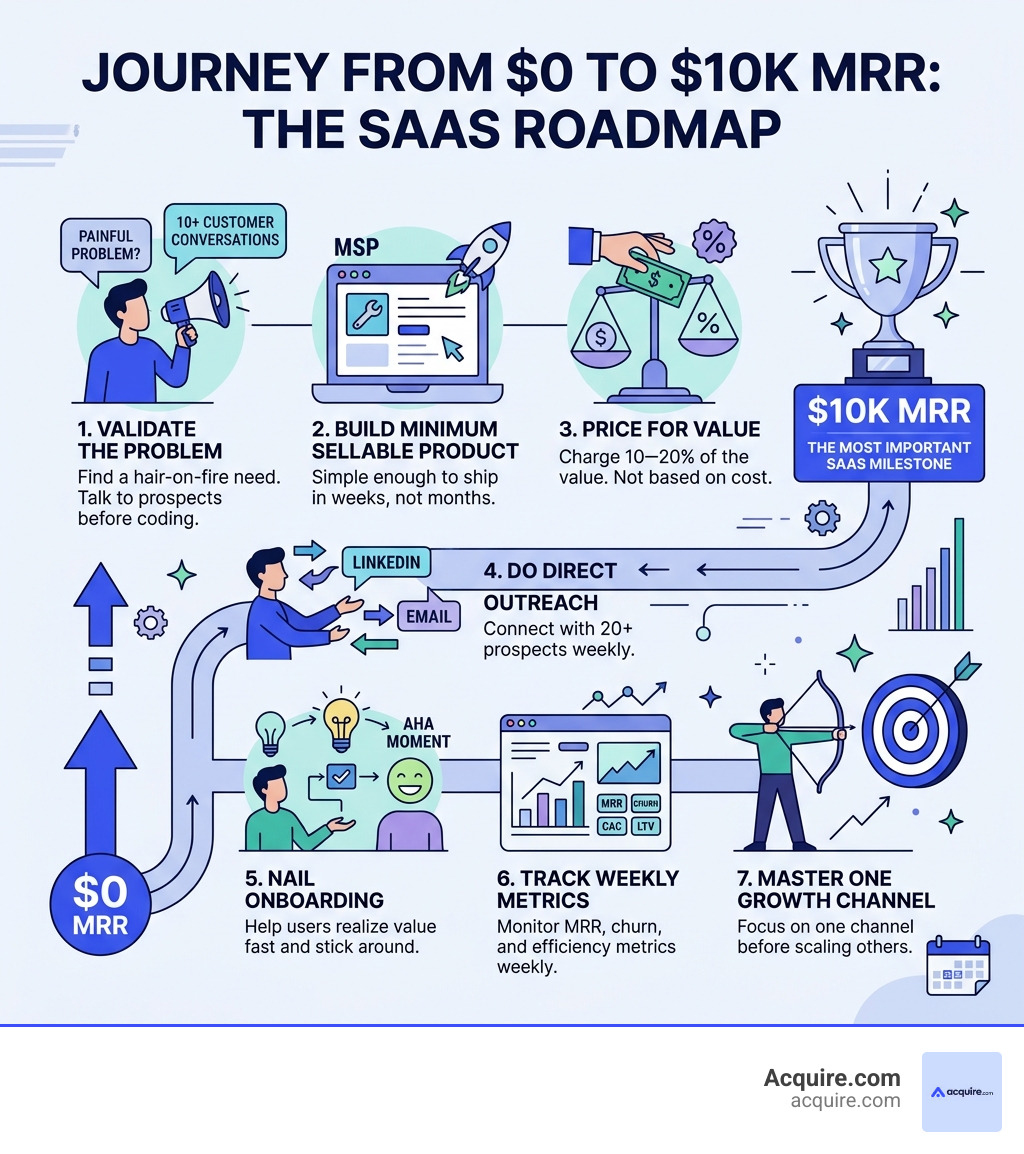
Here’s the quickest path to $10K MRR:
- Validate a painful problem by talking to 10+ potential customers before writing a line of code
- Build a Minimum Sellable Product — something simple enough to ship in weeks, not months
- Price for value, not cost — charge 10–20% of what the problem is worth to your customer
- Do direct outreach — connect with 20+ prospects weekly through LinkedIn and cold email
- Nail onboarding so users reach their “aha moment” fast and stick around
- Track MRR, churn, CAC, and LTV weekly — not monthly
- Master one growth channel before touching a second one
Hitting $10K MRR isn’t just a revenue target. It’s the moment your SaaS stops feeling like a real business. Bootstrapped SaaS like Bannerbear took 16 months to cross this line. Others have done it in 6. The difference usually isn’t luck — it’s the order of decisions.
The hard truth? Most founders stall under $10K because they build before validating, underprice out of fear, or spread themselves thin across too many channels. The SaaS graveyard is full of “cool ideas” that nobody paid for.
This guide gives you a clear, step-by-step roadmap to fix that.
Validating the Problem and Your Ideal Customer Profile
Before you write a single line of code or hire a developer, you must ensure you are solving a “hair-on-fire” problem. In SaaS MRR under 10k, the biggest risk isn’t technical failure; it’s building something nobody wants to buy.
We’ve seen that the most successful founders identify friction where people are already spending money inefficiently. Are they using a messy web of spreadsheets? Are they paying for three different tools to do one job? That is where your opportunity lies. To find these spaces, look at job boards, G2 reviews, or subreddits. Ask yourself: “What is the spreadsheet this team can’t kill?”
Validation requires stepping out of your IDE and into a conversation. We recommend interviewing 20 to 30 people in your target niche. This isn’t about pitching; it’s about listening to their daily grind. You want to understand their “Jobs to Be Done.” For example, an AI Resume ATS Analyzer SaaS solves the specific, painful problem of job seekers getting rejected by automated systems before a human ever sees their resume.
Creating Your Ideal Customer Profile (ICP)
Your ICP is a detailed description of the customer who gets the most value from your product and provides the most value to your business. At the sub-$10k stage, your ICP should be narrow. Don’t try to sell to “all marketers.” Sell to “solo ad agency owners managing $50k+ in monthly spend.”
A strong ICP includes:
- Demographics: Industry, company size, and job title.
- Psychographics: Their goals, fears, and the specific “boring” pains they face daily.
- Decision-Making Power: Can this person actually swipe a credit card, or do they need five layers of approval?
For more on how to spark these ideas, check out this guide on Idea Generation for SaaS.
Building a Minimum Sellable Product for SaaS MRR Under 10k
Many founders get stuck in the “MVP” (Minimum Viable Product) trap, building something that is technically viable but commercially useless. Instead, we advocate for the MSP: Minimum Sellable Product.
The difference is simple: An MVP proves it can work; an MSP proves someone will pay for it. Your MSP should focus on one core feature that solves the primary pain point better than the current manual alternative. Take this Profitable AI Image to Code SaaS as an example—it focused ruthlessly on one thing: turning an image into HTML/CSS in seconds.
Best Practices for your MSP:
- Ruthlessly Simple: If a feature doesn’t directly solve the core pain, cut it.
- Shipping Fast: Aim to have a version in users’ hands within 4 to 8 weeks.
- Technical Stack: Use what you know. Don’t learn a new language for a new project. Whether it’s React, Node.js, or a No-Code builder, speed of iteration is your only competitive advantage.
- No Perfection: A “Minimum Lovable Product” is great, but “Minimum Sellable” comes first. If it’s “embarrassing” but solves a $500 problem, people will buy it.
Pricing and Sales Strategies to Hit Your First $10k
Pricing is often the most difficult lever for founders to pull. A common mistake in the SaaS MRR under 10k bracket is underpricing. Founders often price at $10/month because they are afraid of rejection. However, underpricing is a silent killer. It attracts “tire-kickers” who demand the most support while providing the least revenue.
Instead, use Value-Based Pricing. Calculate the ROI your tool provides. If your software saves an agency 10 hours of work a week (valued at $100/hour), you are creating $4,000 of monthly value. Charging $400/month (10% of the value) is a bargain for them. This High-Margin SaaS maintains a 90% profit margin because it stays focused on high-value delivery rather than competing on price.
Strategies to boost MRR quickly:
- Annual Plans: Offer two months free in exchange for an annual commitment. This provides immediate cash flow to reinvest in growth.
- Charge Early: Don’t offer a “forever free” plan too soon. Even a $29/month starting price filters for serious users.
- Tiered Pricing: Create a “Pro” or “Agency” tier. You might find that 20% of your users are willing to pay 5x more for white-labeling or team features.
For a deeper dive, review these 5 steps to a $10k MRR SaaS.
Mastering Direct Outreach and Sales
At this stage, “founder-led sales” is your greatest asset. You shouldn’t be running expensive Facebook ads yet. Instead, you need to do the “unscalable” work of manual outreach.
We suggest a “Prospecting System”:
- Identify: Find 20-50 prospects a week on LinkedIn or niche communities.
- Connect: Send personalized messages. Mention a specific pain point they likely have.
- Demo: Get them on a 15-minute call. Show them exactly how your MSP solves their problem.
Tools like AI Cold Email Enrichment SaaS can help automate the “grunt work” of finding data, but the initial outreach should feel human. Focus on one channel—whether it’s LinkedIn, cold email, or Twitter DMs—and master it for three months before moving to the next.
Optimizing Onboarding and Retention to Prevent Churn
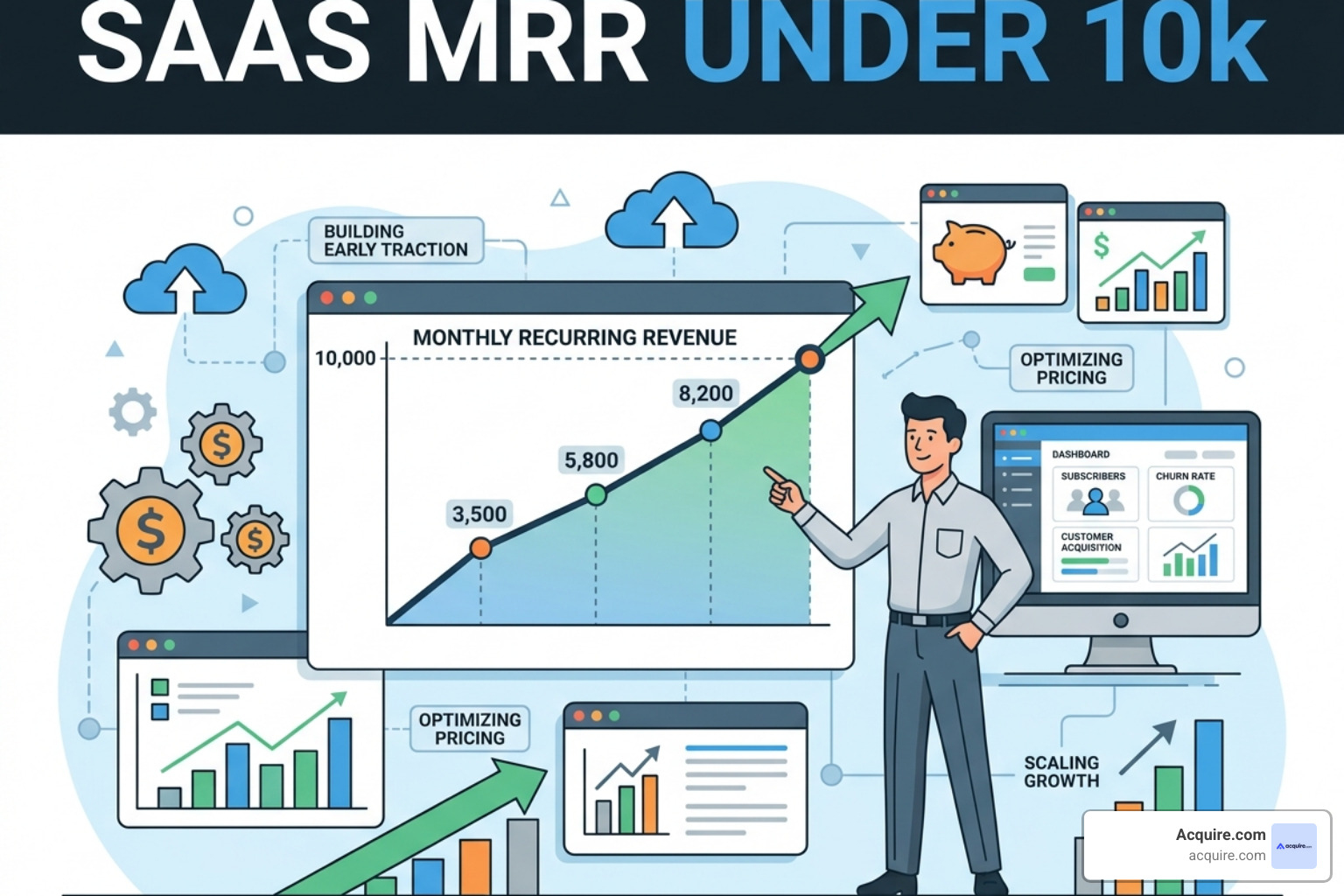
Acquiring a customer is only half the battle. If your churn rate is 10%, you have to replace your entire customer base every 10 months just to stay flat. Retention is the secret to scaling SaaS MRR under 10k.
The most critical window is the first 5 minutes after a user signs up. They need to reach their “Aha Moment”—the instant they realize the product’s value. If you have a Profitable All-in-One SEO Content SaaS, the “Aha” moment isn’t signing up; it’s seeing a perfectly optimized article generated in seconds.
How to reduce churn:
- Personal Onboarding: For your first 50 customers, offer to hop on a call and set it up for them.
- In-App Success Cues: Use tooltips to guide users to the core feature.
- Health Scores: Track how often users log in. If a “Power User” hasn’t logged in for 7 days, send a personal “How can I help?” email.
- Fix Bugs Overnight: At this size, your speed of support is a feature.
Essential Metrics for a SaaS MRR Under 10k Dashboard
You can’t manage what you don’t measure. You don’t need a complex enterprise suite, but you do need to keep track of your Monthly Recurring Revenue with precision.
We recommend tracking these metrics on a weekly dashboard:
- New MRR: Revenue from new customers.
- Expansion MRR: Revenue from existing customers upgrading.
- Churn Rate: The percentage of customers leaving each month. (Aim for <5%).
- LTV (Lifetime Value): How much a customer is worth over their entire relationship with you.
- CAC (Customer Acquisition Cost): How much you spend to get one customer. (LTV should be at least 3x CAC).
- ARPU (Average Revenue Per User): To hit $10k MRR, you generally need 100 customers at $100/mo or 200 at $50/mo.
For those using Stripe, tools like Saascast offer effortless revenue forecasting so you can see where your business is headed 30 days from now.
Scaling and Tracking Your SaaS MRR Under 10k
Once you hit $5k MRR, it’s time to start thinking about Growth Loops. A growth loop is a system where one action leads to another, fueling further growth. For example, a “Powered by [Your Tool]” badge on a free tier can drive new traffic.
As you move toward the $10k mark, you can begin to transition from founder-led sales to more scalable channels. This is the time to build a “Content Engine”—taking the questions you answer every day in sales calls and turning them into blog posts or LinkedIn guides.
We see many founders achieve 97% Profit Margins with 100 Paying Customers by focusing on organic growth and referral programs. Happy customers are your best salespeople. Ask for a referral the moment a customer tells you they love the product.
For a long-term view, check out this guide on how to scale a SaaS business after $10K MRR.
How long does it realistically take to reach $10k MRR?
The timeline varies, but here is what the data shows:
- The Solo Founder (Full-Time): Usually takes 6 to 12 months of consistent execution.
- The Side-Hustle Founder: Often takes 12 to 18 months. Bannerbear, for instance, hit $10k after 16 months of focused iteration.
- The “Blitz” Approach: With high-ticket B2B sales (e.g., $500/mo plans), some founders reach $10k in as little as 3 to 6 months by closing just 20 high-value customers.
The key is the iteration rhythm. If you ship an update once a month, you’ll grow slowly. If you ship every week and talk to users every day, you’ll find the path much faster.
What are the most common mistakes founders make at this stage?
We’ve seen thousands of startups, and the same patterns of failure emerge:
- Underpricing: Being the “cheapest” is a race to the bottom.
- Over-Engineering: Building “nice-to-have” features before the “must-have” is polished.
- Ignoring Churn: Focusing only on new signups while the “bucket” is leaking.
- Automated Marketing Too Early: Trying to run ads or SEO before you actually know who your ICP is and why they buy.
- Lack of Focus: Trying to solve five problems for five different industries. Pick one and win it.
Conclusion
Reaching $10k MRR is a massive achievement. It proves that your idea has real market potential and that you have the discipline to execute. Once you hit this milestone, your options open up. You can continue to scale toward $100k MRR, or you might decide it’s time for an exit.
At Acquire.com, we specialize in helping founders realize the value of their hard work. Whether you’ve built a high-margin micro-SaaS or a growing B2B tool, our marketplace connects you with over 500,000 vetted entrepreneurs looking for their next acquisition.
If you’re curious about what your business could be worth, or if you’re looking to acquire a head-start on your next journey, browse our SaaS companies for sale today. The roadmap to $10k is just the beginning—we’re here to help with whatever comes next.