


Why Your Business Depends on Getting LTV Right
Let’s be honest: Many SaaS founders think they have a handle on Lifetime Value (LTV), right up until their financials start looking shaky. I’ve talked to founders who’ve scaled their businesses from nothing to eight figures, and one thing always comes up: nailing your LTV calculations is the foundation of every important business decision. It’s like your business compass, pointing you toward sustainable growth.
Calculating LTV for SaaS isn’t about chasing vanity metrics. It’s about truly understanding the long-term health of your business. Companies that treat LTV as just another number often find themselves burning cash without a clear path to profitability. I’ve witnessed this firsthand. They chase user growth at all costs, often leading to trouble down the line.
Savvy operators, on the other hand, leverage LTV insights to make informed decisions. They know their Customer Acquisition Cost (CAC) limits, how to price their product for sustainable profitability, and where to invest in growth. For example, imagine a SaaS company eyeing a new market. A solid LTV analysis can reveal whether that market will actually deliver profitable customers or just be a costly distraction.
Over the past decade, SaaS businesses have increasingly relied on LTV to inform these critical decisions, with best-practice formulas evolving to incorporate not just gross revenue, but also gross margin and churn rates. Discover more insights on SaaS metrics. This shift shows a growing understanding of the importance of profitability, not just top-line growth. It’s a move toward sustainable business models that can handle market ups and downs.
A thorough LTV analysis can also uncover hidden opportunities. I’ve seen companies discover their ideal customer segments – the ones everyone else missed – simply by digging deeper into their LTV data. This allows them to focus on what works and ditch strategies that drain resources. By the end of this guide, you’ll understand why LTV isn’t just a number; it’s the key to unlocking sustainable growth for your SaaS business. It’s about making smart, data-driven decisions that set you up for long-term success.
The LTV Formula That Actually Makes Sense
Forget the complicated LTV formulas that make you feel like you need an MBA. Let’s talk about the practical calculations that actually work for SaaS businesses. I’m talking real-world stuff, not theoretical textbook examples.
One of the biggest pitfalls I see is how people calculate churn rate. Mess this up, and your LTV calculations become a fantasy. Instead of simply counting how many customers cancel, focus on the revenue you lose. Trust me, a handful of high-paying clients churning hurts way more than a bunch of smaller accounts disappearing.
So, what’s the right way to calculate LTV in SaaS? The core formula is pretty straightforward: LTV = ARPU / Customer Churn Rate. Your ARPU (Average Revenue Per User) is just your average monthly recurring revenue per customer. For instance, if your ARPU is $150 and your churn rate is 5%, your basic LTV is $3,000.
Of course, it’s not always that simple. The way we calculate SaaS LTV got a lot more accurate after 2018, when product analytics tools and cohort analysis became more common. Think of it this way: a 5% monthly churn means the average customer sticks around for 20 months. With a $150 ARPU, that’s $3,000 before even thinking about costs. Want a deeper dive? Learn more about SaaS LTV.
Here’s the real game-changer: using gross revenue instead of gross margin in your LTV calculation can completely throw off your strategy. Gross revenue is your total revenue without considering costs, while gross margin factors in what it actually costs to deliver your service. Let’s say your gross margin is 70%. That $3,000 LTV you calculated? It’s actually $2,100 after factoring in costs. That 30% difference is huge and impacts how much you can invest in growth. Speaking of which, you might find this helpful: How to calculate ARR.
Understanding the connection between LTV and your customer acquisition cost is essential. A good article on Lead Generation for SaaS can offer some valuable perspectives. Plus, there are other wrinkles to iron out, like how to deal with customers who upgrade or downgrade their subscriptions. These real-world scenarios? Textbooks don’t even touch them. We’ll unpack these tricky bits in a moment.

Finding Clean Data in Your Messy Systems
Getting your SaaS LTV calculations right hinges on having reliable data. You could have the most elegant formula, but if your data’s a mess, your results are meaningless. Trust me, I’ve seen this firsthand, wrestling with company metrics, and clean data is the absolute key.
So, where do you even begin? Your billing system is the logical starting point, but don’t assume it’s giving you the complete picture. Often, it tracks billed revenue, not what you actually collected. Things like failed payments, refunds, and disputes can skew the numbers. Also, consider discounts and annual plans—your monthly Average Revenue Per User (ARPU) needs to reflect these accurately, especially when calculating LTV for specific groups of customers (cohorts).
For a deeper dive into the LTV formula itself, check out this helpful resource: How To Calculate Customer Lifetime Value.
Handling Tricky Data Scenarios
Let’s get into some real-world wrinkles. What if customers upgrade or downgrade their subscriptions mid-cycle? This impacts your ARPU calculation. One practical solution is using a weighted average ARPU. This takes into account the percentage of customers on each pricing tier, giving you a more realistic average revenue figure.
Seasonal businesses present another challenge. Churn rates can fluctuate dramatically, making LTV predictions tricky. In this case, analyze churn over a longer period, like a full year, to smooth out the seasonal bumps. Segmenting your customers by their signup date can also reveal cohorts more susceptible to seasonal churn.

Practical Workarounds for Incomplete Data
What if you’re a newer SaaS company and simply don’t have years of historical data? This is a common scenario. One workaround is using proxy metrics. For instance, if you lack long-term churn data, look at early indicators like trial-to-paid conversions or initial customer engagement. These can hint at customer stickiness and potentially foreshadow future churn.
Finally, remember that data cleaning is an ongoing effort, not a one-time fix. A solid data infrastructure is essential for accurate LTV calculations and overall business health. By tackling these data challenges proactively, you’ll be well-positioned for smarter LTV analysis and better decision-making.
Advanced Segmentation That Reveals Hidden Gold
So, you’ve nailed down the SaaS LTV basics. Fantastic! But here’s the insider tip: the truly successful SaaS businesses don’t just calculate one LTV. They dig deeper, segmenting their customer base to pinpoint their most profitable users. This is where the real magic happens.
Because let’s be honest, not all customers are equal. A large enterprise client will likely have a much higher LTV than a small business, even if their monthly fees are similar. Why? Enterprise clients often sign longer contracts, have more users, and tend to stick around longer. Segmentation helps you see these crucial differences.
Slicing and Dicing Your Customer Base
How do you segment? There are a few approaches. You can segment by acquisition channel. Customers from paid ads might have a lower LTV than those from organic search or referrals due to the higher upfront acquisition costs.
Other valuable segmentation criteria include company size, usage patterns, and contract terms. Power users are gold. Customers locked into annual contracts are more valuable than those on month-to-month plans. Getting clean, integrated data is key. This article on data integration solutions might be helpful. Ultimately, the goal is to identify the segments most valuable to your specific business.
Real-World Examples and Insights
I’ve witnessed this firsthand. A marketing automation platform I worked with discovered its enterprise customers had 3x the LTV of their SMB segment. This discovery completely reshaped their strategy. They reallocated resources to focus on acquiring and, importantly, retaining those high-value enterprise clients. Sophisticated SaaS platforms are using even more granular segmentation, often by cohorts or revenue tiers. I saw one case where a SaaS platform found their top 10% of users (paying over $200/month with a retention of over 36 months) generated over 40% of total LTV.
To illustrate different approaches, let’s look at the following table:
LTV Calculation Methods by Customer Segment
Comparison of different LTV calculation approaches for various customer segments, including data requirements and complexity levels
| Segment Type | Calculation Method | Data Required | Complexity Level | Best Use Case |
|---|---|---|---|---|
| Small Business | Simplified LTV (ARPU / Churn Rate) | Average Revenue Per User (ARPU), Churn Rate | Low | Early-stage SaaS, limited data |
| Mid-Market | Custom LTV (Gross Margin * (ARPU / Churn Rate)) | ARPU, Churn Rate, Gross Margin | Medium | Growing SaaS, more detailed analysis |
| Enterprise | Cohort-based LTV (Track LTV for specific signup groups over time) | Customer acquisition cost (CAC), ARPU, Churn Rate by Cohort | High | Mature SaaS, in-depth customer understanding |
| Freemium | Segmented LTV (Separate LTV for free and paid users) | Conversion Rate from free to paid, ARPU for paid users, Churn Rate for paid users | Medium | Freemium model businesses |
This table summarizes various LTV calculation methods tailored to different customer segments. As you can see, the complexity increases with the level of detail and data available.
Cohort Analysis and Contract Lengths
Cohort analysis is a powerful tool for understanding LTV. A cohort is a group of customers sharing a common characteristic, such as their signup date. Analyzing the LTV of different cohorts over time reveals important trends. You might discover, for instance, that customers acquired in a specific month have a surprisingly high LTV, offering valuable clues about the effectiveness of specific marketing campaigns.
And don’t forget about contract lengths! Customers on annual contracts have a different LTV calculation than those on monthly contracts. This needs to be factored into your segmentation. This might seem like a lot to consider, but the resulting insights are worth the effort. They illuminate hidden opportunities and empower you to make data-driven decisions that can significantly impact your bottom line.
Benchmarking Your Numbers Against Reality
Calculating your SaaS LTV (Lifetime Value) is essential, but it’s only half the battle. It’s like having a powerful engine without a steering wheel. You need to understand how your LTV stacks up against the competition and industry standards. That’s where benchmarking becomes invaluable. It gives you the context you need to see if your LTV is a cause for celebration or a sign of trouble brewing.
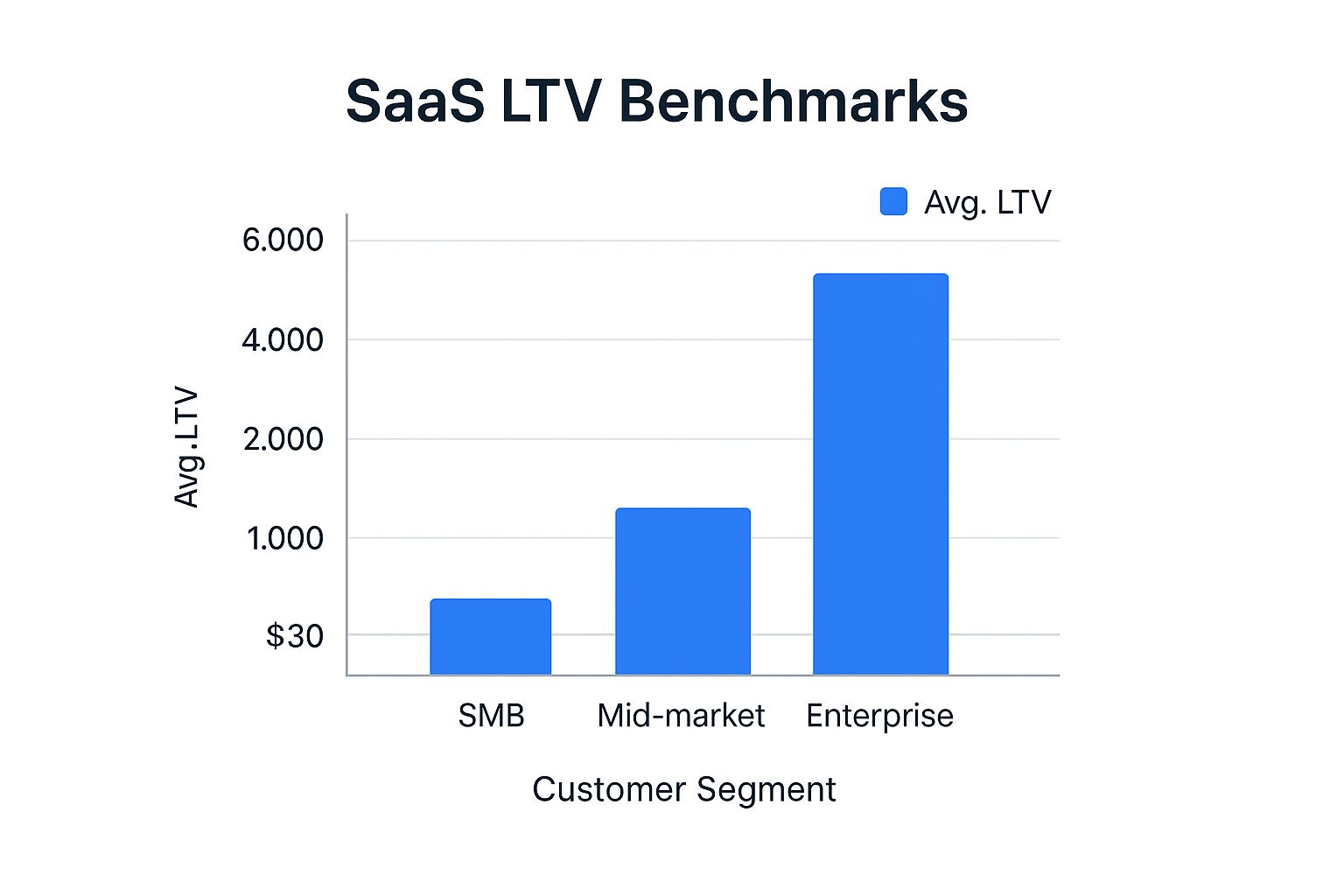
This chart gives you a general idea of average SaaS LTV benchmarks, broken down by customer segment: $300 for SMB, $1,200 for mid-market, and $6,000 for enterprise. Enterprise clients, as you can see, offer the potential for much higher LTV. But remember, these are just averages. Your actual LTV will depend heavily on your specific niche.
Industry Benchmarks and LTV-to-CAC Ratios
Let’s say you’re a fintech SaaS company. Your LTV expectations will be completely different from a company selling project management software. Why? Because fintech often targets large enterprises with significant budgets, while project management tools cater to a broader audience, including smaller businesses. This fundamental difference in customer profile directly impacts LTV.
Just as important is the LTV-to-CAC (Customer Acquisition Cost) ratio. This metric is like a financial health check for your business. Industry benchmarks suggest a healthy LTV-to-CAC should be at least 3:1 by 2025. However, some sectors, like Adtech, might see ratios as high as 7:1. For example, in SaaS business services, a 3:1 ratio with an LTV of $2,400 and a CAC of $800 is typical. Meanwhile, Adtech companies might see an average LTV of $6,800 against a CAC of $956. Want to learn more? Dive deeper into these benchmarks.
Benchmarking Against Relevant Competitors
Comparing your metrics to broad industry averages can be misleading. It’s much more useful to benchmark against your direct competitors. Who are they? What kind of LTVs and CACs are they achieving? Understanding their performance gives you a much clearer picture of your own strengths and weaknesses. If a competitor boasts a significantly higher LTV, it’s a great opportunity to learn. Are they attracting higher-value customers? Are they doing a better job at retaining them?
Beyond your competitors, take a look at what’s happening within your own customer base. Are certain acquisition channels bringing in higher LTV customers? Do specific features correlate with higher retention and LTV? Understanding Net Revenue Retention (NRR) can be really helpful here.
By understanding these nuances, you can fine-tune your strategies to improve both sides of the LTV-to-CAC equation. Maybe you need to tweak your pricing, revamp your onboarding process, or invest more heavily in certain marketing channels. Benchmarking provides the data-driven insights you need to make these crucial decisions. Finally, keep in mind that market conditions and timing can skew your LTV, so always view your numbers critically. Don’t be afraid to question your own data and look for potential biases.
Let’s look at some real-world data to illustrate these concepts:
To give you a better sense of how LTV, CAC, and the all-important LTV:CAC ratio play out in different industries, I’ve put together this table:
Real-world LTV and CAC benchmarks across different SaaS verticals with industry-specific insights
| Industry | Average LTV | Average CAC | LTV:CAC Ratio | Key Factors |
|---|---|---|---|---|
| SaaS Business Services | $2,400 | $800 | 3:1 | Focus on customer success and retention |
| Adtech | $6,800 | $956 | 7:1 | High customer lifetime value due to recurring ad spend |
| Project Management Software | $500 | $200 | 2.5:1 | Competition and freemium models impact LTV |
| Fintech | $5,000 | $1,500 | 3.3:1 | High contract values and longer customer lifecycles |
This table showcases how different industries experience varying LTVs, CACs, and LTV: CAC ratios. Notice the impact of factors like recurring revenue in Adtech and high contract values in Fintech. These factors significantly influence the overall financial health of businesses in these sectors. Use this table as a starting point for your own benchmarking efforts, and remember to dig deeper into your specific niche for the most relevant comparisons.
Avoiding the Mistakes That Kill Businesses

Let’s be honest, I’ve seen more SaaS companies trip up on LTV (Lifetime Value) calculations than nail it on their first attempt. These aren’t small stumbles; they’re critical errors that can derail your decision-making and burn through valuable resources. It’s like building a skyscraper on sand – eventually, the whole thing collapses.
One of the most common mistakes? Using total revenue instead of recurring revenue. This can inflate your LTV, sometimes by a shocking 40% or more. You think you’re on solid financial footing, only to realize your LTV projection is a complete fantasy. I’ve seen this firsthand, and the fallout can be brutal.
Seasonal Pitfalls and Timing Traps
Seasonal businesses often get caught in a different kind of trap – misreading churn patterns. They might see a temporary spike in cancellations during a specific season and freak out, not realizing it’s just a normal ebb and flow. This kind of overreaction can lead to hasty, ill-informed decisions. Instead of panicking, zoom out. Look at churn over a full year to get the real story. Want to get a handle on churn? Check out our guide on how to reduce churn in your SaaS business.
Misjudging customer acquisition timing is another major culprit. Imagine pumping a ton of money into marketing at the very end of the quarter. Those brand new customers haven’t had a chance to generate much revenue yet. This gives you a wildly optimistic, and ultimately inaccurate, LTV projection. It’s like comparing a seedling to a fully grown tree.
Building Safety Nets Into Your Process
So, how do you avoid these LTV landmines? First, be incredibly precise with your data. Double-check that you’re using recurring revenue, not total revenue. It’s a simple but crucial step.
Second, really understand the natural cycles of your business. If you’re a seasonal business, factor those fluctuations into your LTV calculations. Don’t let normal variations throw you off course.
Finally, don’t put all your eggs in one basket. Don’t just rely on LTV. Look at other vital signs like customer engagement and retention. They provide invaluable context for your LTV numbers. Build regular checks into your process. For example, compare your projected LTV against actual customer revenue on a regular basis. Do they match up? If not, dig in and find out why. Catching these mistakes early can save you a world of pain later.
These aren’t just theoretical concepts; they’re real-world challenges that can make or break your SaaS business. By understanding these potential pitfalls, you’re building a more resilient, successful company for the long haul.
Turning LTV Insights Into Competitive Advantages
Calculating LTV (Lifetime Value) for SaaS is just the starting point. The real magic happens when you use these insights to outmaneuver your competitors. It’s like knowing your car’s fuel capacity – helpful, but not enough to win a race. Knowing when to pit stop and how to optimize your driving – that’s what gives you the edge. Smart SaaS operators use LTV insights to make better decisions about pricing, customer retention, and acquisition.
Pricing Optimization Based on LTV
Let’s talk pricing. Understanding your LTV empowers you to justify premium pricing for your high-value customer segments. If you know a particular group will stick around longer and generate significantly more revenue over their lifetime, charging them a premium makes perfect sense. This allows you to reinvest more in serving them, further boosting their LTV. It’s a win-win. On the flip side, LTV can also guide you in offering discounts to price-sensitive segments, as long as their LTV still justifies the cost of acquiring them.
Retention Strategies Driven by LTV
Think about retention. High LTV customers are your VIPs. Treat them accordingly. Investing in dedicated customer success managers, personalized onboarding experiences, and proactive support can yield enormous returns by reducing churn and extending the lifetime value of these key customers. I’ve witnessed companies completely transform their retention rates by simply prioritizing customer segments with the highest LTV potential.
Smarter Acquisition Investments
LTV data profoundly impacts your acquisition strategy. It tells you how much you can reasonably spend to acquire a new customer. You can calculate your maximum allowable CAC (Customer Acquisition Cost) by using your target LTV-to-CAC ratio. For example, if you’re aiming for a 3:1 ratio and your target LTV is $3,000, you know you can spend up to $1,000 on acquisition. This allows you to concentrate resources on the channels and campaigns that bring in the most valuable customers, instead of wasting time and money chasing cheap leads that churn quickly.
Communicating LTV Insights to Stakeholders
Sharing LTV insights with investors and stakeholders is essential. While they might not be interested in the intricacies of the LTV formula, they are interested in growth and profitability. Present your LTV analysis in terms of business outcomes. Demonstrate how improving LTV impacts revenue, reduces churn, and improves the overall health of your business. This is how you translate complex metrics into a story that resonates with decision-makers.
By translating LTV insights into actionable strategies, you’re not just crunching numbers; you’re building a sustainable competitive advantage. This moves you beyond simply understanding your customers to actively shaping their lifetime value and, ultimately, the future of your business.
Want to explore more strategies for maximizing the value of your SaaS business? Acquire.com offers a wealth of resources and expert guidance for SaaS founders looking to buy or sell. Discover how Acquire.com can help you achieve your business goals.